Downy woodpecker
Dryobates pubescens (Linnaeus, 1766)
The downy woodpecker is the smallest woodpecker native to North America, a black-and-white bird with a short, stubby bill that visits suet feeders and picks insects off bark, shrubs and tall weeds.

Quick facts
| Kingdom | Animalia[4] |
|---|---|
| Phylum | Chordata[4] |
| Class | Aves[4] |
| Order | Piciformes[4] |
| Family | Picidae[4] |
| Genus | Dryobates[4] |
| Species | Dryobates pubescens[1] |
| Authority | (Linnaeus, 1766)[1] |
| ITIS TSN | 1145276[4] |
| Synonyms | Dendrocopos pubescens (Linnaeus, 1766); Picoides pubescens (Linnaeus, 1766); Picus pubescens Linnaeus, 1766; Dendrocopos pubescens; Picoides pubescens[2] |
| Other common names | —[3] |
| Length | 14.5–17 cm (5.71–6.69 in)[6] |
| Weight | 21–28 g (0.74–0.99 oz)[6] |
| Lifespan (max. recorded / range) | 11.9 years[6] |
| Eggs per season | 3 to 8[6] |
| Diet type | omnivore[6] |
| Habitat | Open deciduous woods, orchards, parks, streamside woods and backyards · ADW biomes: forest forest mountains mountains[6] |
| IUCN Red List | Least Concern (LC)[5] IUCN page Population trend: not available through GBIF; see the IUCN assessment. |
Where it lives
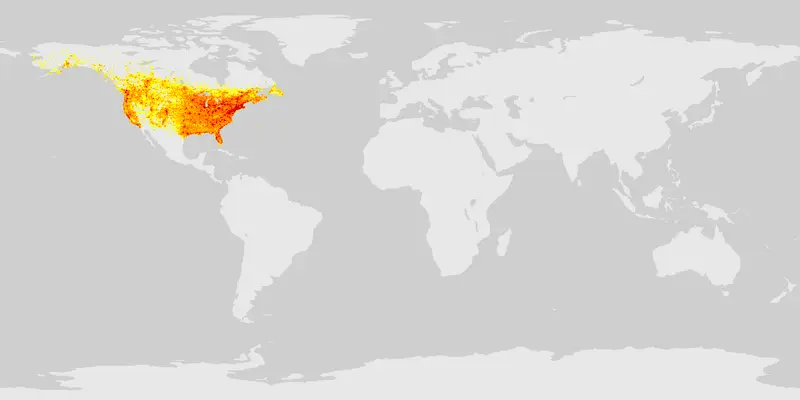
Downies live across a huge sweep of North America, from southeastern Alaska east to Newfoundland and south as far as southern California and Florida. Most of them are year-round residents, so a downy that comes to your suet in December may well be nesting in a nearby tree the following spring. A few populations, mainly along the Atlantic coast, make short local movements instead. In the North they favor open woods of broadleaf trees, such as oak and hickory or beech and maple, and they are scarcer in pure conifer forest unless leafy trees grow underneath. Farther south they lean toward moist woods along rivers and stands of aspen and willow, and they also reach into the southern Rocky Mountains. Orchards, city parks and leafy suburbs suit them too. When and where to look: winter is a good time, because bare branches make these small birds easier to spot and they come readily to suet. Listen for a sharp "pik" note, which often leads straight into a fast rattle. In late winter and spring, listen for drumming as well. That quick tapping is a signal rather than a meal, used to claim a territory, attract a partner and keep in touch with a mate, and it is often the easiest way to find a downy before you see it.
When & where in the US
GBIF holds 16,155,865 occurrence records of this species from the United States. States with the most records:
- New York 1,308,223
- Pennsylvania 1,069,587
- Ohio 894,391
- Massachusetts 822,923
- Michigan 814,902
Occurrence records reflect where and when people look and report (observer effort), not just where the animal is common. Busy birding states and summer months are over-represented; zoo and museum records can appear for non-native species.
Source: GBIF occurrence search for country US.[8]
What it eats
Downies are omnivores, though insects and other small arthropods sit at the top of the menu. Beetles and weevils, ants, true bugs, aphids, caterpillars, scale insects and spiders are all on the list. A downy collects prey from the surface of trunks, twigs and big weed stalks, pokes into bark cracks, and chips out shallow holes in the wood to reach hidden larvae. Compared with the larger hairy woodpecker, it tends to work on smaller branches and stems. Because it eats wood-boring beetle larvae and other insects that people count as pests, it is a helpful bird to have around orchards and yards. Plant foods fill out the rest of the diet: fruit, seeds, sap and a little of the soft living tissue under bark. At feeders, suet is the main draw. Males and females often forage in different ways; in one study in Illinois, males spent more time digging into wood, while females spent more time probing the bark surface. Downies also need water, and they scoop it up with the bill from puddles, streams, ponds, bird baths and the little pools that collect on flat limbs.
Reproduction and life cycle
Pairs usually start to form between January and March. Downies are monogamous, and once a male and female team up they forage side by side until incubation begins, which may be a way for each to keep an eye on its mate. Many pairs stay together through the summer, and some reunite in later years. Together the two birds carve a nest hole, usually in a dead limb of a tree that may itself be alive or dead. The digging takes from about one week to nearly three, and it usually starts a couple of weeks before the first egg. The female lays one egg a day until the clutch is complete, typically somewhere between three and eight. Both parents incubate; the male takes the night shift and they trade off during the day. The eggs hatch together after about twelve days. The chicks are helpless at first but grow fast, and a parent keeps them warm almost constantly for their first few days. Both adults feed them and keep the nest clean, and the young leave the hole roughly three weeks after hatching. For at least three more weeks the parents keep feeding the fledglings, lead them to food and warn them of danger. Most youngsters are ready to breed the next year. Now and then an extra female, usually unrelated to the pair, helps out at a nest. Because downies dig into dead wood, leaving safe dead limbs on old trees gives them places to nest, and their old holes are later taken over by other cavity-nesting birds.
Threats and conservation
Downy woodpeckers are common, with numbers that look stable and in some areas are climbing. They are listed as Least Concern and are protected under United States migratory bird law. Birds of prey are their main enemies, including sharp-shinned hawks, Cooper's hawks, northern goshawks and peregrine falcons. In towns, rats and pet cats also catch them. Eggs and chicks face climbing raiders such as snakes and squirrels, and even other woodpeckers, including red-bellied and hairy woodpeckers. Nesting inside a cavity keeps out many animals that cannot reach in. When a hawk comes near, a downy may press itself flat against the bark and freeze, or slip behind a branch and keep circling it so the hunter cannot get a clear line. Downies also host several kinds of parasitic flies, including blowflies. Within its own kind, each sex defends a territory against intruders of the same sex, using wing flicks, a fanned tail, a raised crest and an upturned bill, and squabbles can turn into midair grappling. Keeping cats indoors and keeping suet feeders clean are simple ways to help.
How to tell it apart
- Black-capped chickadee: A similar small backyard bird at feeders, but the chickadee has a solid dark cap and bib and a tiny bill. The downy shows a white stripe down a black back, white spots on black wings and, in males, a small red patch on the back of the head.
- House sparrow: About the same size at the suet cake, yet the sparrow is brown and streaked. The downy is crisp black and white, with a white stripe above and below each eye and a stubby chisel-like bill.
- Northern mockingbird: Gray and white with white wing flashes, which can look woodpecker-like in flight, but the mockingbird has a long tail, a slim bill and no black-and-white spotting or red head patch.
- Blue jay: Shares the same feeders and backyard trees, and also has black and white on the wings, but the jay is much larger, mostly blue and crested. A downy is small, with white underparts and white outer tail feathers barred with black.
Photo: (c) Alexis Williams, some rights reserved (CC BY) — CC BY 4.0, source[9]. See all image credits.
Sources
- GBIF Backbone Taxonomy — Dryobates pubescens (species 9149595), via GBIF API — retrieved 2026-11-21
- GBIF — synonyms of Dryobates pubescens — retrieved 2026-11-21
- GBIF — vernacular names of Dryobates pubescens — retrieved 2026-11-21
- ITIS — full hierarchy for TSN 1145276 — retrieved 2026-11-21
- IUCN Red List category via GBIF (Dryobates pubescens) — retrieved 2026-11-21
- Animal Diversity Web (University of Michigan) — Dryobates pubescens account — retrieved 2026-11-21
- GBIF occurrence density map tile for Dryobates pubescens — retrieved 2026-11-21
- GBIF occurrence search — Dryobates pubescens, country US, month and state facets — retrieved 2026-11-21
- iNaturalist taxon 792988 — Dryobates pubescens (photo source) — retrieved 2026-11-21

Written under the pen name Maya Reynolds with AI-assisted drafting, then checked against the sources cited on each page. Last reviewed 2026-11-21. Numbers in the fact table come only from the linked sources; all prose is original. See our editorial policy.