House sparrow
Passer domesticus (Linnaeus, 1758) · also called Common House Sparrow, Domestic Sparrow, English Sparrow, European Sparrow, Gutter Bird, House/Eurasian Tree Sparrow
The house sparrow is a stocky Old World sparrow, native to Eurasia and North Africa and brought to North America from England in the eighteen fifties, that lives almost anywhere people have built farms, homes or cities.

Quick facts
| Kingdom | Animalia[4] |
|---|---|
| Phylum | Chordata[4] |
| Class | Aves[4] |
| Order | Passeriformes[4] |
| Family | Passeridae[4] |
| Genus | Passer[4] |
| Species | Passer domesticus[1] |
| Authority | (Linnaeus, 1758)[1] |
| ITIS TSN | 179628[4] |
| Synonyms | Fringilla domestica Linnaeus, 1758[2] |
| Other common names | Common House Sparrow, Domestic Sparrow, English Sparrow, European Sparrow, Gutter Bird, House/Eurasian Tree Sparrow[3] |
| Weight | 28.5 g (1.01 oz)[6] |
| Lifespan (max. recorded / range) | 13 years[6] |
| Eggs per season | 1.0 to 8.0[6] |
| Length | Not available from our sources |
| Diet type | omnivore[6] |
| Habitat | Farms, towns, cities and other places shaped by people |
| IUCN Red List | Least Concern (LC)[5] IUCN page Population trend: not available through GBIF; see the IUCN assessment. |
Where it lives
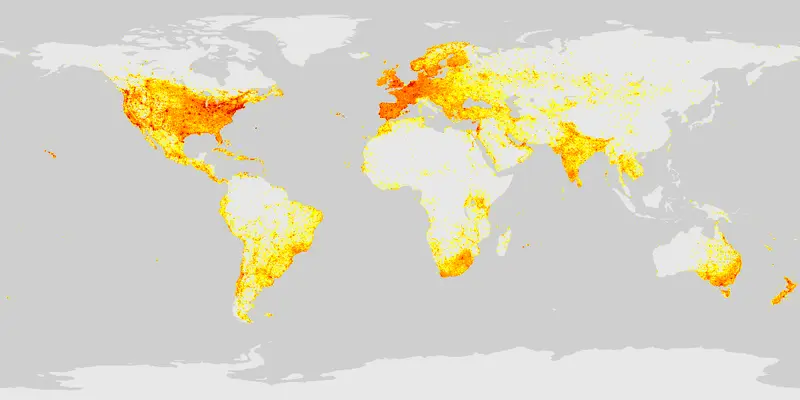
This bird now lives on nearly every continent apart from the polar regions. Its original home was Europe, Asia and North Africa, and people carried it to southern Africa, South America, Australia, New Zealand and the Americas. The North American story starts in Brooklyn, New York, in eighteen fifty-one, when a group of about one hundred birds shipped over from England was set free. At first the newcomers were sheltered from predators and even fed, and the population then grew enormously across the continent. What the sparrow really needs is people. It settles on farms, along residential streets and in city centers, and it is missing from wild woodland, forest, desert and grassland where nobody lives. It is a sedentary bird, so a local flock tends to stay in the same neighborhood through the year. In community records gathered by GBIF, the largest numbers of United States sightings come from New York, Texas, California, Illinois and Pennsylvania, and reports peak in May. When and where to look: farmyards, busy streets, parks and gardens with feeders. Listen for chirping groups and watch the ground, where these birds hop instead of walking.
When & where in the US
GBIF holds 13,501,002 occurrence records of this species from the United States. States with the most records:
- New York 1,214,618
- Texas 908,972
- California 892,420
- Illinois 818,959
- Pennsylvania 745,320
Occurrence records reflect where and when people look and report (observer effort), not just where the animal is common. Busy birding states and summer months are over-represented; zoo and museum records can appear for non-native species.
Source: GBIF occurrence search for country US.[8]
What it eats
The thick, stubby bill of this sparrow is a clue to its menu: seeds make up most of what it eats, with some insects on the side. Where a bird lives changes the details. Country sparrows pick a lot of waste seed out of animal dung and gather grain in fields, while town birds rely more on store-bought birdseed and the seeds of weeds. Older studies that examined stomach contents from birds in nine states, from Alabama and Mississippi up to Vermont and Michigan, found that livestock feed such as corn, wheat and oats made up the biggest share, roughly three-fifths. Stored or field cereals and weed seeds each made up a bit under a fifth, and insects only a small sliver. Fruit and spiders or other small arthropods are listed as extra foods too. House sparrows search for food on the ground in small flocks, hopping along between short flights. Feeding together has a safety benefit, since many pairs of eyes keep watch for an approaching hawk. In the air the flight is direct, with steady flapping and no gliding. Because flocks eat so much seed, the species can affect local plant life, and around farms it is considered a crop pest.
Reproduction and life cycle
Pairs stay together for one breeding season at a time. In North America breeding runs from February through August, and nests go up from about February into May. A favorite site is a gap or crevice in or on a building, though the birds also nest in both conifers and broadleaf trees. The nest is a loose pile of dry plant material, feathers, string and paper. A clutch can hold anywhere from one to eight eggs, and a pair may produce as many as four clutches in a single season. The parents wait until the last egg is laid before they start incubating. Then male and female take turns on the eggs in brief spells of only a few minutes, and the eggs hatch in about ten to fourteen days. The chicks hatch naked and helpless, and both adults brood them and bring food, which they regurgitate for the young. The nestlings fledge at around two weeks. Sparrows guard only a small space right around the nest, not their feeding spots. Within that zone they can be fierce: they have been seen threatening or attacking some seventy other kinds of birds, and fights are usually male against male or female against female. They also use body postures and a set of calls to attract mates, warn off intruders and alert others to danger. One banded wild bird lived past thirteen years, though most survive only a few.
Threats and conservation
The IUCN lists the house sparrow as Least Concern, and the bird is not considered threatened. In the United States it has no special status under federal migratory bird law, and it is left out of most Canadian and American wildlife regulations. Numbers have dropped since the nineteen sixties, a decline linked to the shift toward large farms growing a single crop. Natural enemies are many. Hawks, falcons and owls hunt the adults, including Cooper's hawks, merlins, snowy owls and eastern screech owls, and northern shrikes take them too. Eggs and nestlings are eaten by house cats, dogs, raccoons and snakes such as black rat snakes. For people, the sparrow is a mixed guest. Big groups around buildings are noisy and leave plenty of droppings, and the birds compete aggressively with native species. They seize nest cavities used by bluebirds, chickadees, cliff swallows and some woodpeckers, sometimes forcing out the adults and nestlings. On the positive side, house sparrows are a key food source for birds of prey near towns, and scientists use them to study broad questions such as how animals evolve and how pests can be controlled.
How to tell it apart
- House finch: Both are small brown birds at feeders. A male house finch has a rosy pink throat and rump and a red line over the eye, and finches show brown streaks on a whitish belly. A house sparrow has a plain pale buff underside, and the male wears a black bib with white cheeks.
- Black-capped chickadee: A chickadee also shows black at the throat, but it has a solid black cap, white cheeks, a tiny pointed bill and a greenish gray back. A sparrow is stockier, with a thick bill and a brown back streaked with black.
- American goldfinch: A female or winter goldfinch is olive brown above and olive yellow below, with dull blackish wings and a sharp conical bill. A house sparrow has no olive or yellow tones and shows a brown back with black streaks.
- Downy woodpecker: Also small and common around yards, but the downy is black and white, with a white stripe down the center of its black back and white spots on the wings. A sparrow shows only brown, black and buff.
Photo: (c) hedera.baltica, some rights reserved (CC BY-SA) — CC BY-SA 4.0, source[9]. See all image credits.
Sources
- GBIF Backbone Taxonomy — Passer domesticus (species 5231190), via GBIF API — retrieved 2026-11-21
- GBIF — synonyms of Passer domesticus — retrieved 2026-11-21
- GBIF — vernacular names of Passer domesticus — retrieved 2026-11-21
- ITIS — full hierarchy for TSN 179628 — retrieved 2026-11-21
- IUCN Red List category via GBIF (Passer domesticus) — retrieved 2026-11-21
- Animal Diversity Web (University of Michigan) — Passer domesticus account — retrieved 2026-11-21
- GBIF occurrence density map tile for Passer domesticus — retrieved 2026-11-21
- GBIF occurrence search — Passer domesticus, country US, month and state facets — retrieved 2026-11-21
- iNaturalist taxon 13858 — Passer domesticus (photo source) — retrieved 2026-11-21

Written under the pen name Maya Reynolds with AI-assisted drafting, then checked against the sources cited on each page. Last reviewed 2026-11-21. Numbers in the fact table come only from the linked sources; all prose is original. See our editorial policy.