House finch
Haemorhous mexicanus (P.L.Statius Müller, 1776) · also called Hollywood Finch, House Finch (Common), House/Purple Finch, Mexican rosefinch, Rose-Breasted Finch
The house finch is a small, streaky finch of towns and open country whose males wear a rosy red throat, brow and rump, a western bird that has spread across much of the United States.

Quick facts
| Kingdom | Animalia[4] |
|---|---|
| Phylum | Chordata[4] |
| Class | Aves[4] |
| Order | Passeriformes[4] |
| Family | Fringillidae[4] |
| Genus | Haemorhous[4] |
| Species | Haemorhous mexicanus[1] |
| Authority | (P.L.Statius Müller, 1776)[1] |
| ITIS TSN | 997805[4] |
| Synonyms | Carpodacus mexicanus (P.L.Statius Müller, 1776); Fringilla mexicana (Müller, 1776); Carpodacus mexicanus[2] |
| Other common names | Hollywood Finch, House Finch (Common), House/Purple Finch, Mexican rosefinch, Rose-Breasted Finch[3] |
| Length | 14 cm (5.51 in)[6] |
| Weight | 19–22 g (0.67–0.78 oz)[6] |
| Lifespan (max. recorded / range) | 11.6 years[6] |
| Eggs per season | 3 to 6[6] |
| Incubation (time to hatching) | 12 to 17 days[6] |
| Diet type | herbivore[6] |
| Habitat | Suburbs, city parks, farms, desert, chaparral and open woodland · ADW biomes: desert or dune desert or dune savanna or grassland savanna or grassland forest forest scrub forest scrub forest[6] |
| IUCN Red List | Least Concern (LC)[5] IUCN page Population trend: not available through GBIF; see the IUCN assessment. |
Where it lives
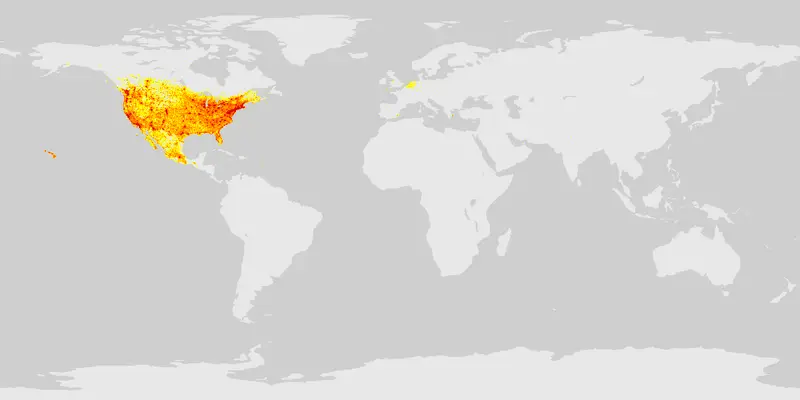
House finches are native to the West, from Oregon, Idaho and northern Wyoming south through California and New Mexico into Mexico, and east to the western edges of Nebraska, Kansas and Texas. There they live in open desert and desert grassland, chaparral, oak savanna, streamside woods and open conifer forest. In the nineteen forties a shipment of house finches was let go on Long Island, New York. The little group struggled for several years, then took hold and spread. Today eastern birds range from southern Canada to the Gulf of Mexico and from the Atlantic coast west to the Mississippi River. The species was also introduced to Hawaii. In the West most house finches stay put all year, but many eastern birds have become migrants that spend the winter in the southern states. When and where to look: in the East this finch is almost entirely a bird of buildings and lawns, so a suburban yard with a feeder is the best bet. In the West, also try desert and scrub. Males do most of their singing in the first hours after sunrise and the last hours before sunset, and spring is when you hear the bright, rambling warble most. Listen too for short "weet" calls that mates use to keep in touch.
When & where in the US
GBIF holds 17,737,596 occurrence records of this species from the United States. States with the most records:
- California 2,923,127
- Arizona 968,781
- Pennsylvania 910,501
- Colorado 778,352
- New York 755,122
Occurrence records reflect where and when people look and report (observer effort), not just where the animal is common. Busy birding states and summer months are over-represented; zoo and museum records can appear for non-native species.
Source: GBIF occurrence search for country US.[8]
What it eats
This finch eats plants almost exclusively: grains, seeds, buds and fruit, plus some flower parts. Common seeds include thistle, dandelion, sunflower and mistletoe. In late summer, cherries and mulberries are favorites. In orchards house finches can damage peaches, apricots, plums, cherries and nectarines, which does not win them friends among growers. They sometimes swallow insects such as beetle larvae and aphids, but these may simply come along with the seeds. Unlike some close relatives, house finches will feed on the ground. In the open they like to have tall perches nearby, or they feed in big flocks, where many eyes watch for danger. They drink by scooping water into the bill and tipping the head back, and they need water at least once a day, so a clean bird bath may help draw them in. The male's red color comes from carotenoid pigments in the food he eats, so a bright male is showing that he is good at finding and competing for rich food. Females appear to prefer the most colorful males. Because flocks crowd together at seed, clean feeders matter a lot for this species.
Reproduction and life cycle
Pairs begin forming in winter, and the bond is settled just before breeding starts. Courting males perform a "butterfly flight": a male climbs high into the air, then glides slowly down to a perch while singing a long, loud song. He also feeds the female and stays close to guard her, singing while she builds. Breeding runs from March into August. The female alone builds the nest, a shallow cup of grasses, hair or whatever fibers are handy. She tucks it into sagebrush and other shrubs, cactus, tree cavities, branches, nooks on buildings or nest boxes. Her eggs are pale bluish or greenish white with black spots near the wide end, usually three to six of them. She does all the incubating, and the male brings her food. The eggs take about two weeks to hatch. For the first few days she broods the chicks constantly; then both parents feed them hard and carry off their droppings. The young leave the nest roughly two to nearly three weeks after hatching. While the male keeps feeding the fledglings, the female starts the next nest. A pair may start as many as six clutches in one summer, though usually no more than three produce young. Once independent, juveniles gather in big flocks at good food sources, and they can breed the following spring.
Threats and conservation
The house finch is common across its range, with an estimated population in the tens of millions, and it is listed as Least Concern. Its numbers have swung up and down because of disease rather than predators, chiefly a bacterial eye infection called mycoplasmal conjunctivitis, along with avian pox. A sick finch has swollen, runny or crusty eyes, and the infection often kills it. Keeping feeders clean is the main way people can reduce it. Adult house finches are most often taken by pet cats, Cooper's hawks and sharp-shinned hawks. Nests are raided by a long list of animals, including blue jays, common grackles, American crows, eastern chipmunks, fox squirrels, rats, skunks, snakes, raccoons and cats. The finches rely mostly on staying alert, and a flock has more eyes on watch. They are not territorial and often nest close to one another in small groups. Within a flock, females usually rank above males. Federal migratory bird law means people cannot capture or keep house finches without a permit. Indoor cats and clean feeding stations are the two easiest ways to help them in a yard.
How to tell it apart
- House sparrow: Both feed in flocks around homes, but neither sex of house sparrow shows red. A male house finch has a rosy throat, brow and rump, and house finches have a whitish belly streaked with brown.
- Northern cardinal: Also red and at the same feeder, but the cardinal is larger, entirely red with a crest and black face, and has a big red bill. A male house finch is red mainly on the throat, brow and rump, with brown streaks on the belly and wings.
- American goldfinch: A small finch at the same feeders. Males are bright yellow with a black cap in summer; in winter both sexes are drab olive with dark wings, but they are never streaked brown below like a house finch.
- Ruby-throated hummingbird: Both are small backyard birds whose males show red at the throat, but the hummingbird is tiny, green-backed and needle-billed, while the house finch has a stout seed-cracking bill and a streaky brown body.
Photo: (c) dennisvo, some rights reserved (CC BY) — CC BY 4.0, source[9]. See all image credits.
Sources
- GBIF Backbone Taxonomy — Haemorhous mexicanus (species 8323485), via GBIF API — retrieved 2026-11-21
- GBIF — synonyms of Haemorhous mexicanus — retrieved 2026-11-21
- GBIF — vernacular names of Haemorhous mexicanus — retrieved 2026-11-21
- ITIS — full hierarchy for TSN 997805 — retrieved 2026-11-21
- IUCN Red List category via GBIF (Haemorhous mexicanus) — retrieved 2026-11-21
- Animal Diversity Web (University of Michigan) — Haemorhous mexicanus account — retrieved 2026-11-21
- GBIF occurrence density map tile for Haemorhous mexicanus — retrieved 2026-11-21
- GBIF occurrence search — Haemorhous mexicanus, country US, month and state facets — retrieved 2026-11-21
- iNaturalist taxon 199840 — Haemorhous mexicanus (photo source) — retrieved 2026-11-21

Written under the pen name Maya Reynolds with AI-assisted drafting, then checked against the sources cited on each page. Last reviewed 2026-11-21. Numbers in the fact table come only from the linked sources; all prose is original. See our editorial policy.