Northern mockingbird
Mimus polyglottos (Linnaeus, 1758) · also called Mocker, Mocking Bird
The northern mockingbird is a long-tailed gray songbird famous for copying the songs of other birds and sounds of its surroundings, and males sing by night as well as by day.

Quick facts
| Kingdom | Animalia[4] |
|---|---|
| Phylum | Chordata[4] |
| Class | Aves[4] |
| Order | Passeriformes[4] |
| Family | Mimidae[4] |
| Genus | Mimus[4] |
| Species | Mimus polyglottos[1] |
| Authority | (Linnaeus, 1758)[1] |
| ITIS TSN | 178620[4] |
| Synonyms | Mimus polyglottus (Linnaeus, 1758); Turdus polyglottos Linnaeus, 1758; Turdus polyglottus Linnaeus, 1758; Turdus polyglottos[2] |
| Other common names | Mocker, Mocking Bird[3] |
| Length | 20.8–25.5 cm (8.19–10 in)[6] |
| Weight | 47–51 g (1.66–1.8 oz)[6] |
| Lifespan (max. recorded / range) | 8 years[6] |
| Eggs per season | 2 to 6[6] |
| Incubation (time to hatching) | 11 to 14 days[6] |
| Diet type | omnivore[6] |
| Habitat | Suburbs, parks, roadsides, farmland, thickets and brushy desert · ADW biomes: desert or dune desert or dune savanna or grassland savanna or grassland scrub forest scrub forest[6] |
| IUCN Red List | Least Concern (LC)[5] IUCN page Population trend: not available through GBIF; see the IUCN assessment. |
Where it lives
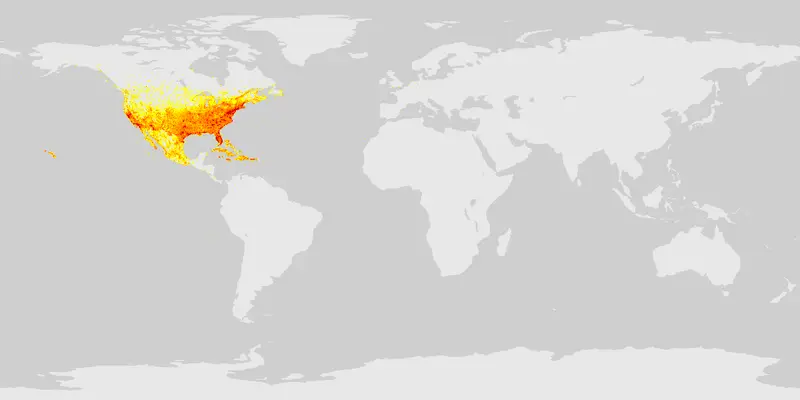
Mockingbirds occur across North America, from Canada through the United States to Mexico, and they were also introduced to Hawaii. They are most plentiful in the southern states, with Texas and southern Florida as strongholds. As a breeding bird the species reaches from northern California, eastern Nebraska, southern Ontario and Atlantic Canada south to southern Mexico. Most birds that nest in the northern part of the range head south for the winter, while those in the South usually stay all year. They like open ground and forest edges: yards and neighborhoods, farms, roadsides, city parks, grassy spots with thickets and brushy desert. Wherever they live, they need a tree or other high perch from which to watch over a territory, and they use the same kinds of places in every season. When and where to look: scan the tops of trees, poles and tall shrubs in open neighborhoods, where a male sings from a lookout. Spring and early summer, the breeding season, is the time for the most singing, and the song carries on at night too. Watch for the big white wing patches and white outer tail feathers that flash when a mockingbird flies.
When & where in the US
GBIF holds 11,075,025 occurrence records of this species from the United States. States with the most records:
- Texas 1,768,077
- Florida 1,401,982
- California 1,256,669
- Virginia 577,332
- North Carolina 531,674
Occurrence records reflect where and when people look and report (observer effort), not just where the animal is common. Busy birding states and summer months are over-represented; zoo and museum records can appear for non-native species.
Source: GBIF occurrence search for country US.[8]
What it eats
Mockingbirds are omnivores that live mostly on insects, berries and seeds. Beetles, ants, grasshoppers and spiders are typical prey, and since some of these are garden pests, the birds do people a favor. Earthworms are on the menu as well, and now and then a mockingbird takes a small crustacean or a small lizard. On the plant side, holly, mulberries, raspberries, dogwood, brambles, grapes and figs are all eaten. Most feeding happens on the ground or while the bird sits perched in a tree or shrub. Because they swallow fruit and pass the seeds, mockingbirds spread many plants around the landscape. Not everyone loves them, though: gardeners and farmers sometimes complain when the birds help themselves to fruit and vegetables. For water they drink from puddles, the edges of rivers and lakes, and drops of dew or rain that gather on leaves. A yard with fruiting plants such as holly or dogwood and a shallow source of water is a good way to invite one in.
Reproduction and life cycle
Male mockingbirds sing to win a mate and to mark their territory, and their range of sounds is astonishing. One bird may perform at least thirty-nine distinct songs and about fifty different calls, and it can copy noises such as barking dogs, pianos, sirens and squeaky gates, as well as other birds. Courtship is lively. A male may chase a female around his territory while calling, or hop along branches in shrubs and trees as if showing her places to build. He also performs a flight display: singing nonstop, he rises a few yards into the air, flashing his white wing patches, then floats slowly back down. Pairs are usually monogamous for a season and sometimes for life. Breeding happens in spring and early summer. The nest is a bulky cup of twigs, cotton, dry leaves, stems, paper and grass, placed in a shrub or tree anywhere from about a foot to around fifty feet up. The female lays two to six bluish or greenish eggs, often marked with brown or reddish spots, and she incubates them alone for about two weeks. Both parents feed and guard the chicks, which leave the nest in less than two weeks. While the female starts a new nest, the male teaches the youngsters to fly and keeps feeding them until they are independent a couple of weeks later. A pair can raise two to four broods a year, and young birds can breed at one year old. During nesting, mockingbirds are bold defenders that attack animals as big as cats, dogs and people.
Threats and conservation
The northern mockingbird has a large population, estimated in the tens of millions, and it is not considered a conservation concern. It is listed as Least Concern and is protected under the federal Migratory Bird Treaty Act. Adults are hunted by sharp-shinned hawks, eastern screech owls, scrub jays and great horned owls, and snakes sometimes kill a female on her nest. Eggs and chicks are taken by blue jays, fish crows, American crows, snakes and squirrels, and American alligators appear on the list of known predators too. When a predator comes close, the adults give alarm calls and often mob it, sometimes hitting it. Three kinds of cowbird lay their eggs in mockingbird nests, leaving the mockingbirds to raise the cowbird chicks. The birds also carry parasites such as blowfly larvae, fleas and mites. People sometimes see mockingbirds as a nuisance, mostly because singing at night can keep a household awake. On the other side of the ledger, scientists value them for their behavior and enormous vocal range, and they eat insect pests and spread seeds.
How to tell it apart
- American robin: Shares lawns and feeds on the ground in the same places, but the robin has an orange breast and a darker back, and it lacks the long tail and big white wing patches of a mockingbird.
- Blue jay: Another loud backyard bird, and one that raids mockingbird nests, but the jay is bright blue with a crest. Mockers are gray-brown above with a long tail and white flashing in the wings.
- Downy woodpecker: Black, white and gray at a glance, yet the downy works along trunks and branches and has bold black and white face stripes. A mockingbird perches upright and has a long, slightly curved black bill.
- Mourning dove: Grayish and long-tailed too, but a dove is plumper and buff-brown with a small head, and it lacks the large white wing patches and white outer tail feathers that flash on a flying mockingbird.
Photo: (c) Morgan Caygill, some rights reserved (CC BY), uploaded by Morgan Caygill — CC BY 4.0, source[9]. See all image credits.
Sources
- GBIF Backbone Taxonomy — Mimus polyglottos (species 5231677), via GBIF API — retrieved 2026-11-21
- GBIF — synonyms of Mimus polyglottos — retrieved 2026-11-21
- GBIF — vernacular names of Mimus polyglottos — retrieved 2026-11-21
- ITIS — full hierarchy for TSN 178620 — retrieved 2026-11-21
- IUCN Red List category via GBIF (Mimus polyglottos) — retrieved 2026-11-21
- Animal Diversity Web (University of Michigan) — Mimus polyglottos account — retrieved 2026-11-21
- GBIF occurrence density map tile for Mimus polyglottos — retrieved 2026-11-21
- GBIF occurrence search — Mimus polyglottos, country US, month and state facets — retrieved 2026-11-21
- iNaturalist taxon 14886 — Mimus polyglottos (photo source) — retrieved 2026-11-21

Written under the pen name Maya Reynolds with AI-assisted drafting, then checked against the sources cited on each page. Last reviewed 2026-11-21. Numbers in the fact table come only from the linked sources; all prose is original. See our editorial policy.